

Dissertation Diary #3: So What? Part 2
Breaking down what we know about networks and social ties - generally and within the context of K-12 education

Toward the end of Part 1, I started bringing in the idea of networks. We all have some baseline understanding of what a network can mean…
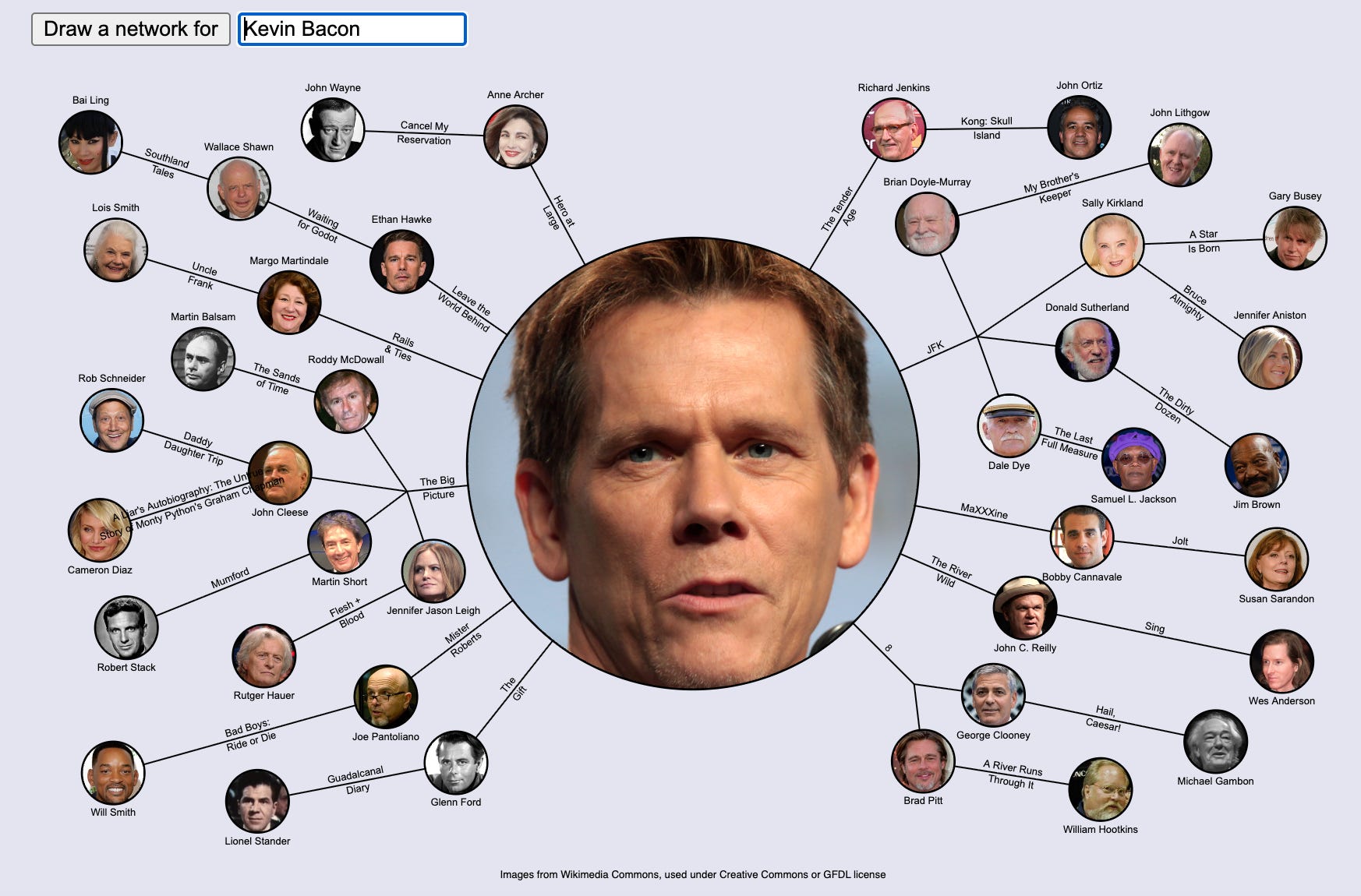
Network can be a verb — the thing you do when you attend a work event and make small talk and try to talk yourself up to others who may be able to connect you to new opportunities. It can also be a noun — the complex map of connections that tells a story of how a series of people, places, events, or entities are related to one another (e.g. the phenomenon of 6 degrees of Kevin Bacon).
There has been a lot of ~discourse~ around networks — how social ties are critical for longevity and quality of life; how are neighborhoods are becoming more politically segregated; how cross-class friendships can reduce poverty; how women bear the role of serving as American’s safety net:

And on and on and on. So I’m sure you can think about this idea of neighborhood networks created through enrollment patterns of public school students through your own lens of networks. But because this Substack is what it is, below I provide a bit of background on sociological research on networks and share what work has been done thus far on the intersection of networks and schools.
A Sociological Perspective on Networks
With well over 78,000 citations according to Google Scholar, it’s safe to say that *the* seminal text on networks in sociology is Granovetter’s “The Strength of Weak Ties.”1 Granovetter argues in this paper for analyzing the interactions between individual people or groups, as such micro-level processes likely aggregate to reveal large-scale, macro-level patterns in our society. He specifically highlights the value of assessing the strength of ties between folks that facilitate interactions and reflect broader social phenomena.
His big takeaway from doing such analysis?
The more local bridges [weak ties] in a community and the greater their degree [how many people are reached by the same bridge], the more cohesive the community and the more capable of acting in concert (1973:1376).
Translation?
Bridges allow you to access otherwise distant parts of a community, thus exposing you to new information, resources, human/social/financial capital. Such access equips that community to work effectively and creatively as a collective. Compare that to a community without bridges — while pockets of that community are likely to be quite tightly knit, because those pockets can’t interact with each other easily via bridges the broader community is more fragmented and less likely to work well together.
Over the last 50 years, this theory of social ties and how they work has been tested and expanded upon in a variety of contexts. For example, a wide body of work has demonstrated the important role space plays in the formation of ties2. Studies have shown that it’s not just physical closeness that drives social relations, but the composition (i.e. the water coolers or coffee stations at an office that allow for interaction, or the parks/churches/coffee shops in a neighborhood that make connecting with others possible) and configuration of space (i.e. the positioning of the water coolers and coffee stations within the layout of offices/cubicles/hallways in the office or the location of the parks, churches, coffee shops, and other fixed places within the geographic boundary-making of a neighborhood via physical infrastructure and social norms ) also influence the likelihood that social ties will form and what the nature of those ties will be. This research emphasizes the need to consider the spatial context when conducting network analyses.
Or, for a more specific example, we can look to Matthew Desmond who introduced the idea of disposable ties3 through his ethnographic work on the experience of an eviction. He found that folks living in poverty in U.S. cities had to form fleeting connections with others who could provide access to needed resources, ultimately using the tie for all that it’s worth then burning the bridge once the usefulness expired. These types of relationships offered necessary support in desperate situations but exacerbated the instability and isolation of life in poverty. Desmond’s main contribution here to the network literature is highlighting where a focus on strong vs. weak ties leaves an incomplete picture of everyday life in urban environments, and thus also opens the door for the possibility of social science uncovering other types of ties or dynamic relationships.
Desmond’s work is a great model for extending Granovetter’s original theory to make sense of certain relationships at work in a highly specific area: urban poor facing eviction. Education scholars have similarly adopted broader social network theories to better understand K-12 school-based phenomena, such as:
Power dynamics across PTOs — do advantaged parents bond together their social capital to hoard opportunities for their children, or do they serve as a bridge across diverse school actors to create an inclusive environment for all students?4
Organizational operations — what kinds of external partnerships do schools make and how do these relationships matter for educational equity?5 (e.g. Eos Trinidad’s research on the impact of outside organizations on the implementation of dropout prediction data systems in three distinct districts6)
School choice — how do the connections parents make with other families while frequenting neighborhood playgrounds influence their approach to kindergarten enrollment?7
These examples don’t even begin to cover the tip of the iceberg, but they give a sense of how Granovetter’s earlier work has spawned different extensions of theorization around social ties and where there may still be new ways to intervene in this large body of work. For my dissertation, that means calculating and analyzing the strength of connections between neighborhoods that are created by students opting out of their assigned neighborhood school and instead enrolling in a different institution in another part of town, then investigating the impact that high levels of geographic diversity via strong or weak ties has on the work of elementary school educators.
Thus concludes Part 2! To recap, I’m using the first four Tuesday posts of this Substack to break down what I’m trying to do in framing my dissertation research: weave together methods and theories from the neighborhood effects and urban networks literature discussed in Part 1 with the methods and theories on tie formation and social connections reviewed here, then contextualize it within the specific sociohistorical and educational context of Philadelphia (Part 3), and ground it all in the foundational questions of the role of schools for children and communities (Part 4).
Hope to see you back here for Part 3!
Granovetter, Mark S. 1973. “The Strength of Weak Ties.” American Journal of Sociology 78(6):1360–80.
Small, Mario L. and Laura Adler. “The Role of Space in the Formation of Social Ties.” Annual Review of Sociology 45(1):111-132.
Review pieces like this one are great resources for gaining an overview of what has been done, what direction the scholarship seems to be moving in, and what questions remain unanswered within a specific subsection of sociology. Annual Review of Sociology and Sociology Compass are two great resources for these types of articles.
Desmond, Matthew. 2012. “Disposable Ties and the Urban Poor.” American Journal of Sociology 117(5):1295-1335.
Murray, Brittany, Thurston Domina, Amy Petts, Linda Renzulli, and Rebecca Boylan. 2020. “‘We’re in This Together’: Bridging and Bonding Social Capital in Elementary School PTOs.” American Educational Research Journal. 57(5):2210-2244.
Bridwell-Mitchell, E.N., James Jack, and Joshua Childs. 2023. “The Social Structure of School Resource Disparities: How Social Capital and Interorganizational Relationships Matter for Educational Equity.” Sociology of Education 96(4):275-300.
Trinidad, Jose Eos. 2025. “From Boardrooms to Classrooms: How Interorganizational Networks Influence Education Policy Adoption.” Educational Evaluation and Policy Analysis 47(3): 847-872.
This is also a good example of doing a little digging and seeing if an open-access pdf of the article exists — Eos links to a Google Drive folder of his academic journal articles right on his academic profile page at Berkeley, offering the chance to read his work to anyone who clicks the link. Here’s the direct link for this cited article.
Bader, Michael D. M., Annette Lareau, and Shani A. Evans. 2019. “Talk on the Playground: The Neighborhood Context of School Choice.” City & Community 18(2):483-508.