

Go Birds
A SpacEd Out love letter to the Philadelphia Eagles on the eve of the playoffs

For the uninitiated, the NFL playoffs begin this weekend — and the Philadelphia Eagles are hosting the San Francisco 49ers at the Linc on Sunday. I’m not going to discuss the game or give any predictions for the Birds’ performance (for that I’d encourage you to go to the historical staple of Philly sports media — WIP Sports Radio — or the rising newcomer, Set Hike!). Instead, I’m going to use this Friday slot to meditate on sports in society and what the Eagles mean for Philadelphia, and me.
Sports often serve as excellent examples of social problems in action. Think racism1, colorism2, sexism3, homophobia4…just to name a few [or, just look to the WNBA where so many of these intersect]. While social science researchers love to emphasize all the ways we continuously, creatively, and more egregiously fail one another and society as a whole as time goes on, there is also a side of sociology that focuses on the integrative propensity of humans. And for that, sports still serve as great case studies.
Take, for example, Gary Alan Fine’s article on the small-group cultures developed by Little League teams5. His theory of culture formation can be applied to so many different kinds of groups — recovery support networks, bible study groups, workplaces, book clubs, etc. But Little League, with its rituals, shared language, particular relationship between fans and players, rules and expectations, serves as a legible blueprint for understanding the why and how behind culture creation.
Even when sports aren’t the explicit focus of social science research, a discerning reader can see where sports fit into other big sociological ideas. Take conversations around cultural taste — studies have highlighted the ability to distinguish wines or possess familiarity with highbrow art forms as pathways into elite connections and opportunities for upper class ascension6 . But sports fit here too. Maybe not for climbing the social ladder, but for feeling bonded to others and a part of a specific community? Absolutely! [Plus, we know from an earlier SpacEd Out post just how valuable weak ties like these can be].
I’ve seen this firsthand since living away from Philly. I survived the isolation of my first year at Cornell (peak COVID-era + first time living apart from my spouse + the grind of being a full-time student again was not a recipe for success) thanks to a coffee shop/bar/market that had strong wifi, few customers, friendly baristas/bartenders, and NFL Sunday Ticket. Following a particular team, knowing some of the sport-specific lore, being able to talk shop even just a teeny bit can open up new forms of connection across race, sex, class, and hometowns. Sports help craft a cultural connective tissue in society.
But before I go any further, I do want to acknowledge the justifiably bad rap football in particular gets — it indeed exemplifies the social ills previously mentioned, as it’s a violent game with complicated racial power dynamics. All that, plus the increased medical understanding of CTE7, makes it fair to question how I can support a program like the NFL.
For a poignant answer, I’d direct you to a piece by Jamil Smith which embraces the both/and of football (and, more broadly, the United States):
For a vulnerable answer, I’d say that the Eagles are to the NFL what my faith is to the Catholic Church. By and large, thanks to its history of abuse, colonialism, greed, misogyny, etc. etc. etc., I don’t support the Catholic Church as an institution. And yet I still have a faith rooted in the spirituality and social justice/liberation theology emphasis of my 16 year+ Mercy and Jesuit education. I was raised Catholic, I’m the product of Catholic schools, I even taught in a Catholic school (but one for students of all faiths) — my faith and who I am is inextricably tied to Catholicism. But I keep the Church and my beliefs separate8. Similarly, I view the Eagles as separate from the NFL. I don’t see myself supporting the NFL so much as I am supporting the Eagles, and by proxy my city, my community, my people.
Because the Eagles are Philly. Walk into a Wawa on Sunday and you’ll hear “Go Birds” as the catch-all phrase to say hello, goodbye, thanks for holding the door. The vibes of your Monday morning commute rest in no small part on the outcome of that week’s game. Bringing up the Eagles is an elevated form of small talk — no need to discuss the weather here when you have hot takes on Sirianni’s coaching, AJ Brown’s reading list, or the latest injuries on the O-line (unless you’re specifically talking about the Action News weather team, in which case, proceed). How many families collected copies of the Philadelphia Inquirer on the days leading up to and after the 2018 and 2025 Super Bowl wins so that a physical reminder of the impossible reality of victory can forever remain in their homes?
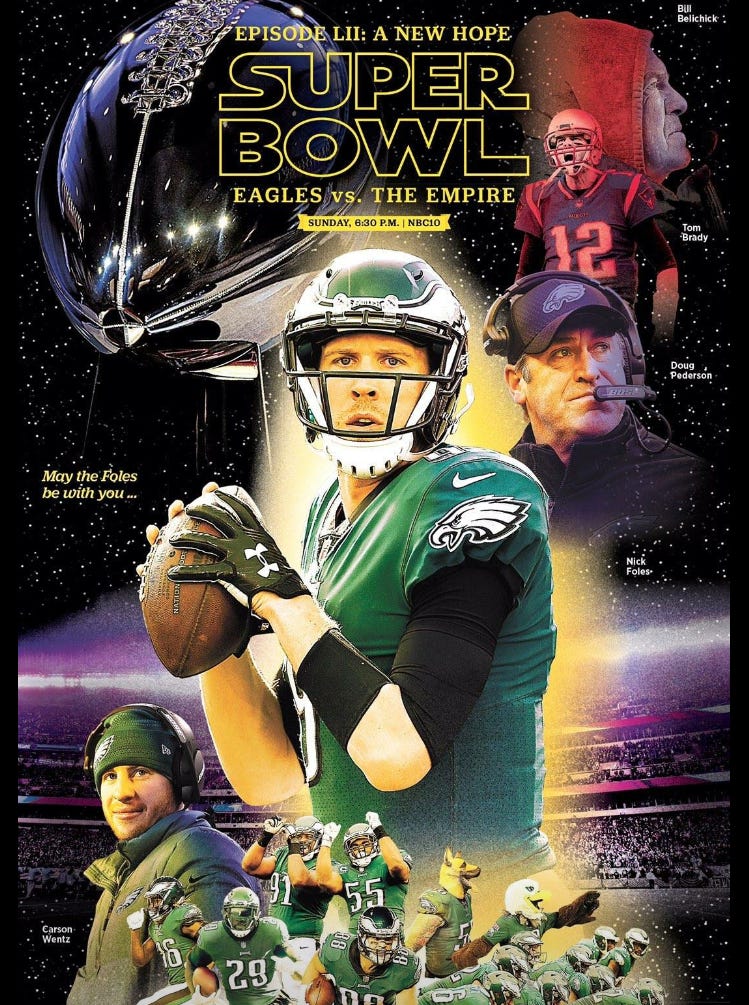
Yes, we’re the snowball-throwing fan base with a straight-up jail in our stadium to deal with the mischief that can come with our passion. A passion so deeply ingrained in our collective urban psyche that even when talking about his heroic efforts to save children from a burning building, a true fan can’t miss the opportunity to roast a disappointing player.
As Philly-born sports critic Tyler R. Tynes wrote after the 2023 Super Bowl loss to the Chiefs,
Perhaps that’s why fandom is our accepted version of psychosis in the sporting congregation. It is the regularity of an agreed upon insanity which — depending on what type of man you are — exists until the end of your life. And, by God, if you’re lucky, infests your kids’ lives too.
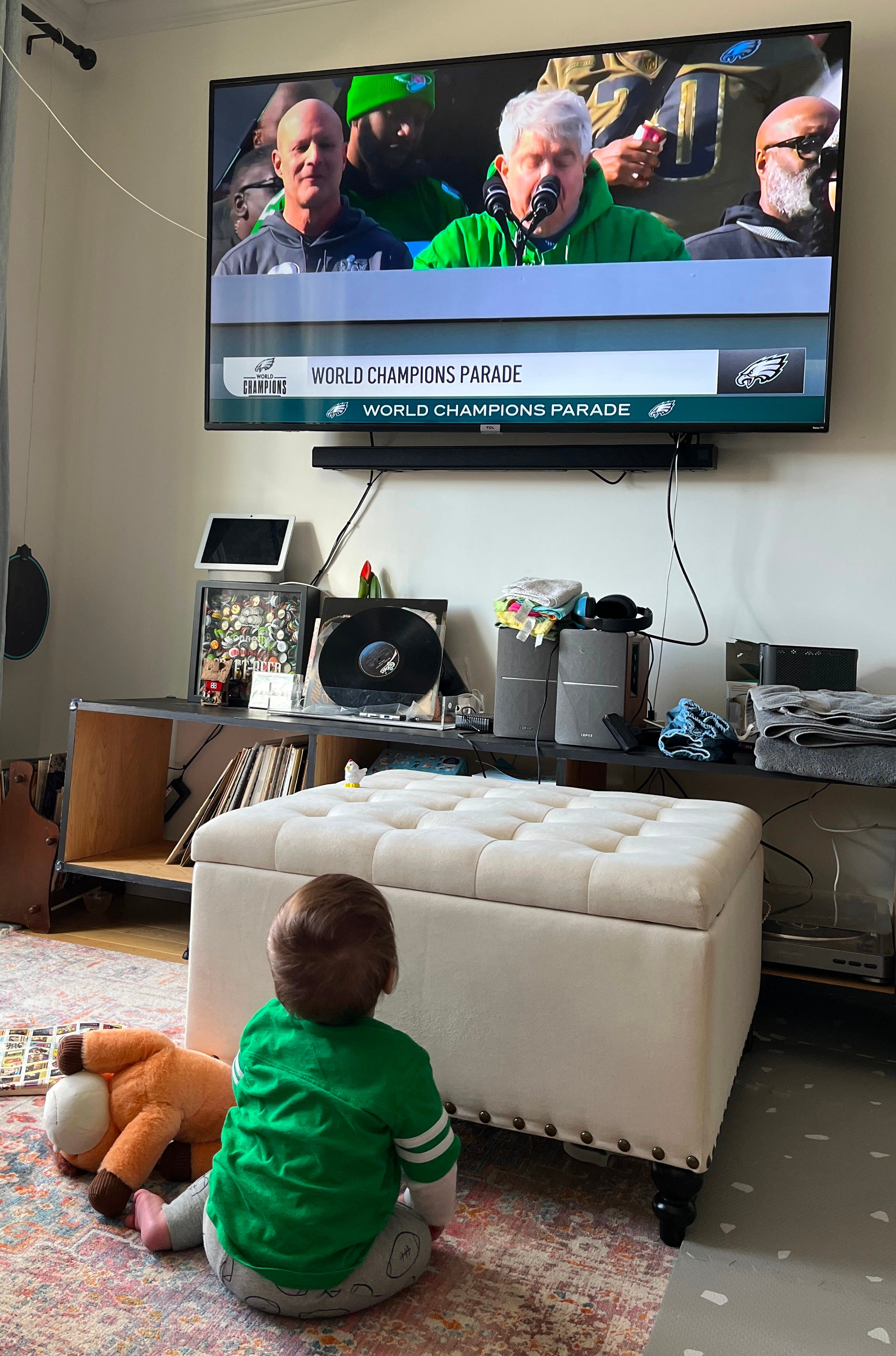
Or, put another way (and paraphrasing Drew Barrymore in Fever Pitch), Eagles fans are romantics — we can love under the best and worst conditions. That’s the spirit that brings me back every year. To partake in the romantic dramedy of Philadelphia sports with thousands of my friends and neighbors and strangers who share that propensity for love. That’s the spirit I want to instill in Jack. He may not be yet baptized by the waters of Christ, but he has certainly been welcomed into the church of Philadelphia fandom.
Marquez-Velarde, Guadalupe, Rachel Grashow, Christy Glass, Anne M. Blaschke, Gary Gillette, Herman A. Taylor, and Alicia J. Whittington. 2023. “The Paradox of Integration: Racial Composition of NFL Positions from 1960 to 2020.” Sociology of Race and Ethnicity 9(4):451-469.
Grindstaff, Laura and Emily West. 2006. “Cheerleading and the Gendered Politics of Sport.” Social Problems 53(4):500-518.
Ezzell, Matthew B. 2009. “‘Barbie Dolls’ on the Pitch: Identity Work, Defensive Othering, and Inequality in Women’s Rugby.” Social Problems 56(1):111-131
At the risk of this turning too academic, I do encourage you to read the abstract — it’s publicly available, and it’s one of my favorites:
Following interactionist theory, this study argues that cultural creation and usage can be examined by conceptualizing cultural forms as originating in a small-group context. Those cultural elements which characterize an interacting group are termed the idioculture of the group. This approach focuses on the content of small-group interaction, and suggests that the meanings of cultural items in a small group must be considered in order to comprehend their continued existence as communication. Five characteristics of cultural items affect which items will become part of a group culture. Cultural forms may be created and continue to be utilized in situations if they are known to members of the interacting group, usable in the course of group interaction, functional in supporting group goals and individual needs, appropriate in supporting the status hierarchy of the group, and triggered by events which occur in group interaction. These elements have impact only through the interpretations of group members of their situations. Support for this approach is drawn from a participant observation study of Little League baseball teams.
I mean come on, this is how you do it!!! It’s at once hilarious and a total hook — if I hadn’t led you a bit with the whole this-will-be-about-sports premise, you would have been shocked getting to that last line, right?! Chef’s kiss.
Bourdieu, Pierre. [1986] 2001. “The Forms of Capital.” Pp. 96-111 in The Sociology of Economic Life, edited bby Richard Swedberg and Mark Granovetter. Boulder, CO: Westview.
Lizardo, Omar. 2006. “How Cultural Tastes Shape Personal Networks.” American Sociological Review 71(5):778-807.
these are just a few examples of long-form journalism addressing the many and various ills of football and the NFL
I fully recognize that this may seem hypocritical and/or naive to some readers — I get that! But this is where I’m at, and it’s the best way I can make sense of the NFL conundrum for myself, which is why I’m sharing this view…and I know that that justification, too, may be hypocritical, naive, and certainly steeped in privilege. It’s not great, I know that — but it’s where I am at this moment.
Fly Eagles Fly! Great read 🦅