

Dissertation Diary #6: Mixed Method Research
Explaining different approaches to mixed method research and sharing which approach I'm using in my dissertation

In the earliest days of SpacEd Out, I introduced my dissertation in a few different posts: a formal abstract, a cheeky conversational explanation of the project, and four deeper dives into the “so what?” of the study. But I haven’t explicitly written about my work in a while, which was kinda the whole point of this endeavor! So I’m jumping back in with some background on mixed methods research and an explanation of which design approach I’m taking with my dissertation.
You might be thinking, “Why mixed methods? Why not just one quantitative study and one qualitative study? Or just one type?” Or maybe you’re even thinking “I don’t know exactly what qualifies as quantitative vs quantitative research” — which is fair! In the most bare-bones definition: quantitative methods use statistical tools to explain associations between independent and dependent variables and seek to generalize to a certain population; qualitative methods set out with research questions (rather than hypotheses) that aim to answer how in order to elucidate the mechanisms and processes behind a social phenomenon. And sometimes, you might need both methodologies to really answer the question(s) you have — in which case, you’ll need to determine which kind of approach to mixed methods research would best fit your needs.

My go-to resources for this methodological approach typically come from the “Qualitative, Survey, and Mixed Method Approaches to Policy Research” course I took in my first semester of my doctoral program, taught by Maureen Waller. The textbook we used early on was Research Design: Qualitative, Quantitative, and Mixed Method Approaches (Creswell and Creswell 2014), which walks through three primary approaches to mixed methods research design: convergent parallel design, exploratory sequential design, and explanatory sequential design.
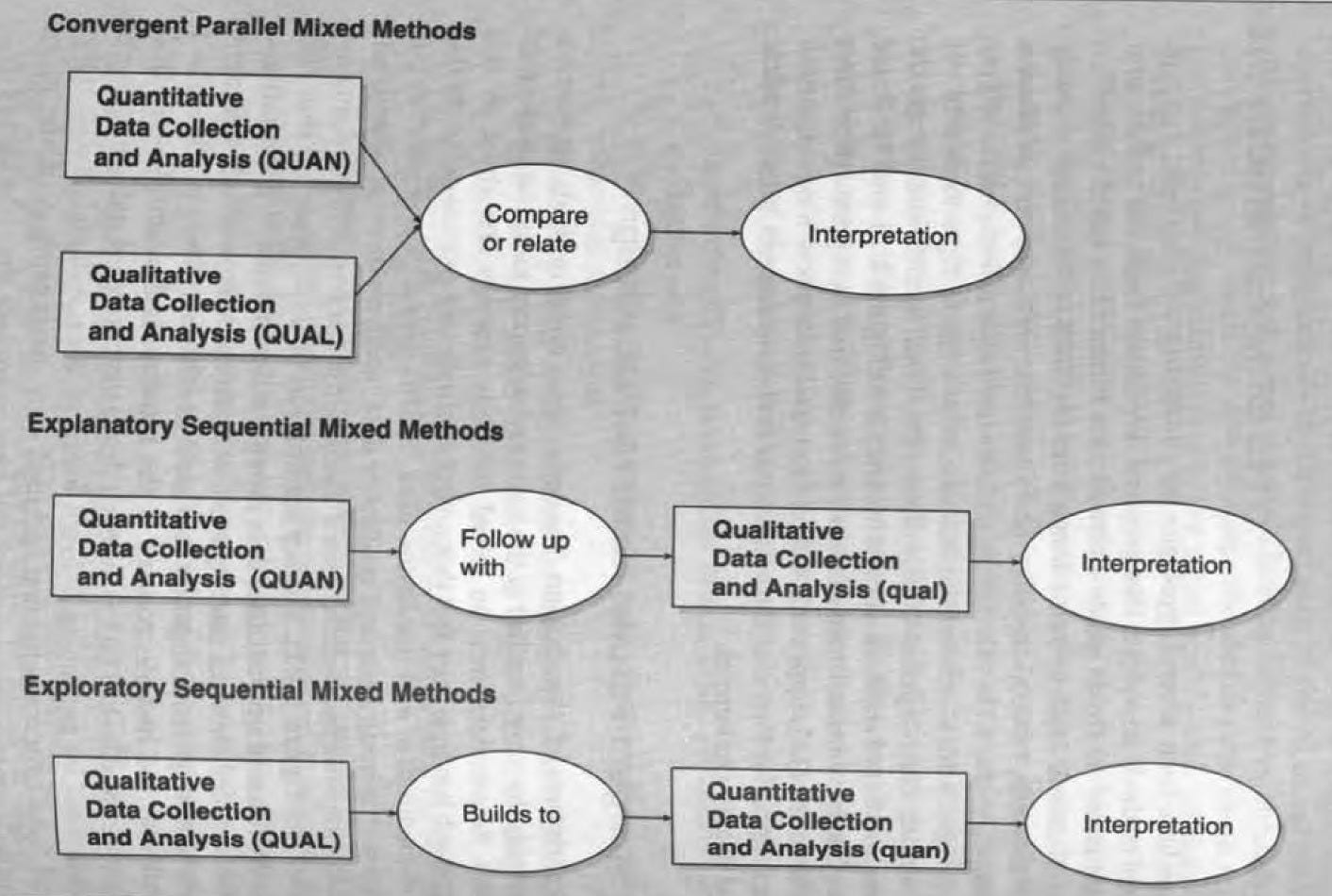
Below, I summarize each approach and offer an open-access example so you can see the methodology in action. Then I’ll share which one I’m using in my dissertation.
Convergent Parallel Design
This design operates under the premise that quantitative and qualitative methodologies yield different kinds of information, but when taken together they can produce complementary insight on the variables, concepts, or constructs under investigation through your research questions. In this approach, data from both the quantitative and qualitative components of the study are considered simultaneously, often side-by-side.
You’ll see this design referred to as “convergent” in texts like Creswell and Creswell 2014, but some may call it “concurrent” — like in “Honoring Local Context: Designing Collaborative Pre-K–12 School Literacy Action Plans” (Kerkoff et al. 2025). They introduce their Methods section with the following paragraph:
To answer our two research questions, we designed a concurrent parallel mixed-methods study (Creswell & Plano Clark, 2017; DeCuir-Gunby, 2020). The study was concurrent in that the qualitative and quantitative data were collected at the same time and parallel in that we first analyzed each source of data separately and then compared our analysis across data sources to develop findings. The research questions were, What factors and processes aided the development of literacy plans? and What impact do educators experience from the process of codesigning local literacy action plans?
They proceed to explain the participants, context, and specific analytical steps taken in their study. But the key here is that to answer their research questions, the authors converged the findings from their quantitative analyses (in this case, online surveys to school administrations) and qualitative analyses (content analysis of literacy plans and professional learning evaluations and reflections) to form substantive conclusions.
Explanatory Sequential
This design mixes the methods through two distinct steps: first, you conduct a quantitative analysis and analyze the data; then, using the findings from the quantitative portion of the study, you design, conduct, and analyze the qualitative phase of the study.
A recent example of this kind of design in action is in “Superintendent Turnover and Retention: A Mixed-Methods Study of Leavers and Stayers in Rural Districts” (DeMatthews et al. 2025). They kick off their Methods section with the following:
In this study, we used an explanatory, sequential mixed-methods design to examine rates of superintendent turnover and understand the individual factors that contribute to voluntary superintendent turnover in rural Texas districts. An explanatory, sequential mixed-methods design can be used to analyze quantitative data first and then explain quantitative results with additional qualitative data (Creswell & Plano Clark, 2017). In the first, quantitative phase of the study, we rely on the Texas Education Research Center (ERC) longitudinal data to determine the demographics and turnover trends among Texas superintendents by district locale, with a focus on rural communities. The state has approximately 1,200 districts total and more than 650 rural districts. We also used public data requests to identify the names and districts of rural superintendents who recently transferred districts (between 2021 and 2022) and superintendents with at least 3 consecutive years of experience in their district to interview for the qualitative portion of this design. We rely on these data to answer the study’s first and second questions focused on rates of superintendent turnover across rural, town, suburban, and urban districts across Texas and factors related to turnover. In the second, qualitative phase, we rely on interviews with rural superintendents to answer the study’s third question focused on factors that contribute to staying and leaving.
This study exemplifies what Creswell and Creswell suggest is the main strength of the explanatory sequential approach: “the idea of explaining the mechanism — how the variables interact — in more depth through the qualitative follow-up” (2014:224). Rather than just identify through the quantitative analyses what characteristics are related to superintendent turnover, the researchers then seek to explain how those characteristics are impacting turnover in this particular way through qualitative means.
Exploratory Sequential
Think of this one as the explanatory sequential in reverse: the qualitative phase happens first in order to inform the quantitative phase. This approach often works best when the researchers want to develop better measurements of a particular concept — so first they get data related to the development of an instrument from qualitative inquiry, use that to create a survey or other quantitative analysis tool, and then administer the quantitative phase to a larger population.
Hoffman, Torres, and Wotipka (2021) write about their use of this design in their paper “Cross-National Variation in School Reopening Measures During the COVID-19 Pandemic”:
In this study, we used an exploratory sequential mixed method design to understand and explain the measures proposed by countries when they decided to reopen schools in the second quarter of 2020. In the qualitative phase of our study, we utilized document analysis (Bowen, 2009) to explore school reopening measures in 49 countries (listed in online Supplemental Appendix A) in order to better understand which policy measures and practices (hereafter referred to as measures) were formulated during the early months of the COVID-19 pandemic. Building on these findings*, we designed the quantitative phase of our study. Using the policy diffusion theory of emulation due to both geographic and political proximity (Shipan & Volden, 2012) as well as complexity theory (Angeli & Montefusco, 2020; Morel & Ramanujam, 1999), we explain cross-national variation in the types of proposed measures across several world regions (East Asia and Pacific, Central Asia and Europe, Latin America and the Caribbean, North America, and Sub-Saharan Africa; The World Bank, 2021).
*emphasis my own
In this paper, the authors use their qualitative analysis of pandemic-era school documents to develop a scoring rubric for reopening policies and practices across dozens of countries. Especially in an unprecedented situation like the COVID-19 school closings, using qualitative analysis to inform the creation of instruments for quantitative analysis makes good methodological sense.
What I’m Using: Explanatory Sequential Design
In the primary project of my dissertation, I investigate the weakening ties between neighborhoods and their local schools through the increasingly common school choice policy of intradistrict open enrollment (aka the ability to enroll in a traditional public school that’s not the one assigned to your home address). To achieve this goal, I first conduct a quantitative phase of the study that assesses which neighborhood- and school-level characteristics predict enrollment in an assigned public school and generates, analyzes, and maps enrollment ties across the School District of Philadelphia. This first phase advances our understanding of the social and structural forces influencing the geographic dispersion of students in a school choice landscape.
But, there’s still a big piece of the puzzle missing — how does this dispersion influence the day-to-day operations of schools? For that, I need to use qualitative methods. I use the findings from the first stage of the study to identify schools with varying levels of enrollment ties and high levels of geographic diversity in their student population. With those schools identified, I then conduct interviews with teachers, staff, and school leaders about how a geographically dispersed student body impacts their work and the operational and cultural priorities of a school, and analyze the data to explore whether there are differences in a school's approach based on the strength of their enrollment ties.
Hopefully this provides some clarity about the use and value of mixed method research (and why I’m using it to answer my research questions). If you have any other questions about mixed methods research, let me know in the comments! Or, just stay tuned for more posts exposing the nitty-gritty, behind-the-scenes realities of this kind of research.